Target Code Generation
What Is Target Code Generation?

Target code generation is the compiler phase where intermediate representation (IR) is converted into instructions that a real processor can execute.
Different CPUs support different instruction sets, so the generated code depends on the target architecture, such as: x86, ARM, RISC-V.
This is the final major phase of the compiler before the program becomes executable.
What Happens in This Phase?
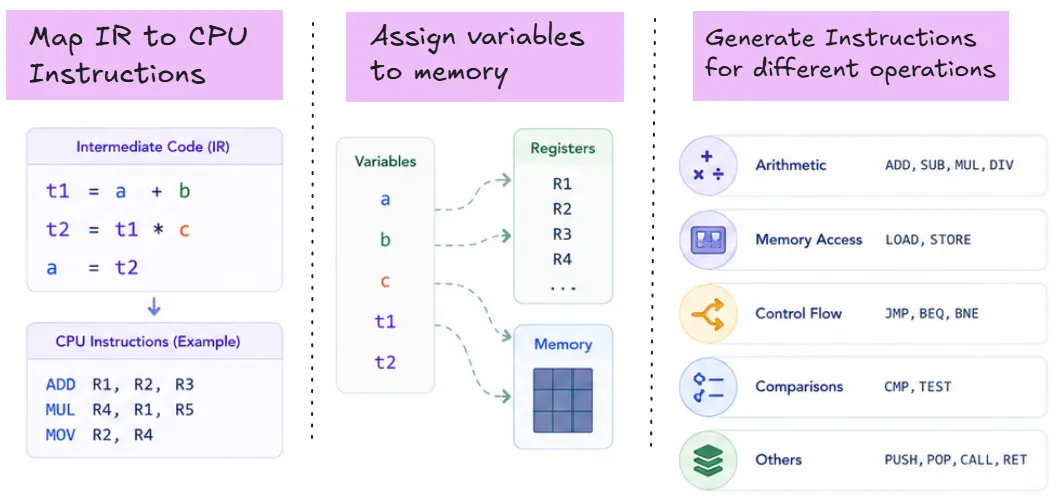
The compiler performs several important tasks during target code generation:
-
Maps IR operations to actual instructions supported by the CPU
Example:
t1 = a + bmay becomeADD R1, R2, R3 -
Allocates variables to CPU registers or memory
-
Generates instructions for arithmetic, memory access, jumps, etc.
The result may be Assembly code (human-readable) or Binary/executable code (for the machine)
Assembly vs Machine Code
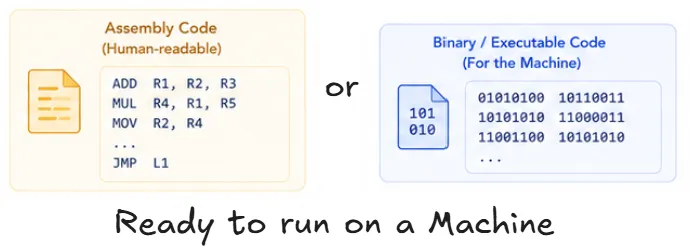
- Assembly Code : Human-readable low-level instructions. Example:
MOV R1, a
ADD R1, b
Assembly is easier for humans to inspect and debug.
- Machine Code: Binary instructions directly understood by the CPU. Example:
10110000 01100001
This is the actual executable form loaded into memory and executed by the processor.
Example: Three-Address Code to Assembly
Intermediate Representation (IR)
t1 = a + b
t2 = t1 * c
Generated Target Code (x86-like)
MOV R1, a
ADD R1, b

MOV R2, c
MUL R2, R1
Here:
- values are loaded into registers
- arithmetic operations are mapped to CPU instructions
- temporary variables are handled using registers
This translation allows high-level program logic to execute directly on hardware.
Conclusion
Target code generation is the bridge between compiler logic and real hardware execution.
It transforms intermediate representations into processor-specific instructions, allocates registers and memory, and produces the final code that the CPU can execute.