Lexical Analysis
What Is Lexical Analysis?
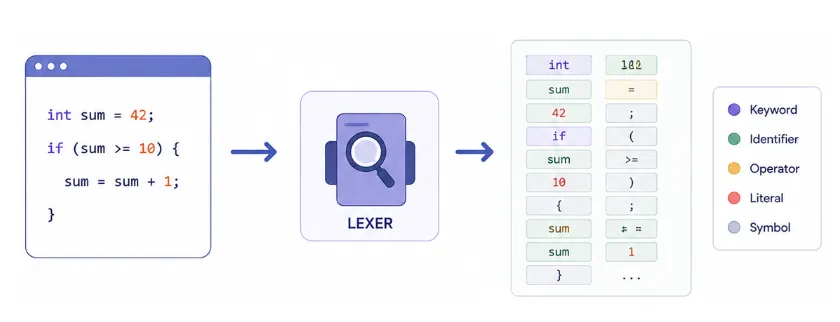
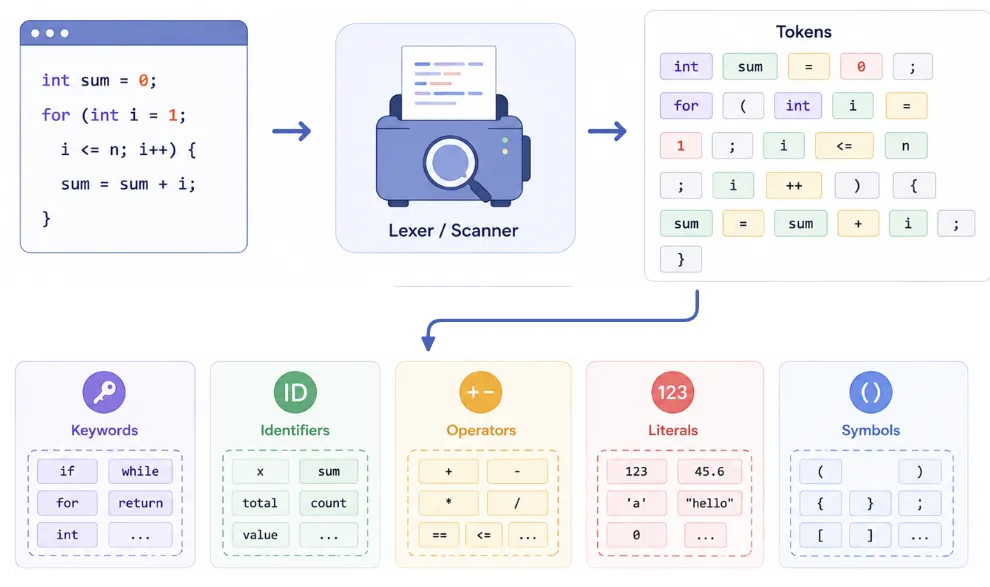
Lexical analysis is the first phase of a compiler. It scans the source code and breaks it into a sequence of tokens, which are the basic building blocks of a program:
- Keywords (
if,while) - Identifiers (
x,sum) - Operators (
+,==) - Literals (
123,'a') - Symbols (
(,),{,})
This process is handled by the lexer or scanner.
What Happens During Lexing?
Lets say you have a input like x = a+b;
- Scanning: Break input string into tokens (lexemes).
[x] [=] [a] [+] [b] [;]
- Evaluating: Convert lexemes into processed values.
[
    (identifies,x),
    (operator,=),
    (identifier,a),
    (operator,+),
    (identifier,b)
]
Now that we know about the two phases., lets take a look at complete picture of how lexical anlysis works.
Lexical Errors
A lexical analyzer may also detect invalid character sequences that do not match any defined token pattern. These are called lexical errors.
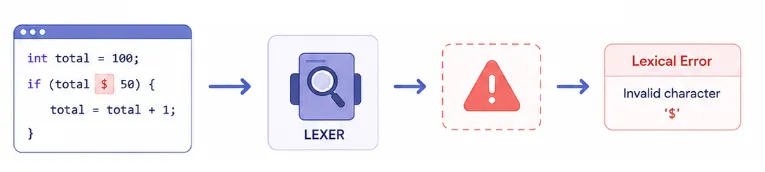
For example:
if(total $ 50)
In above code, the symbol $ may be considered invalid if it is not part of the language grammar, causing the lexer to throw a lexical error.
Tools & Techniques
Lexical analyzers are built using two important concepts:
-
Regular Expressions (Regex)
Used to describe token patterns such as identifiers, numbers, operators, and keywords. -
Finite Automata
Used internally to efficiently recognize and match those patterns while scanning source code.
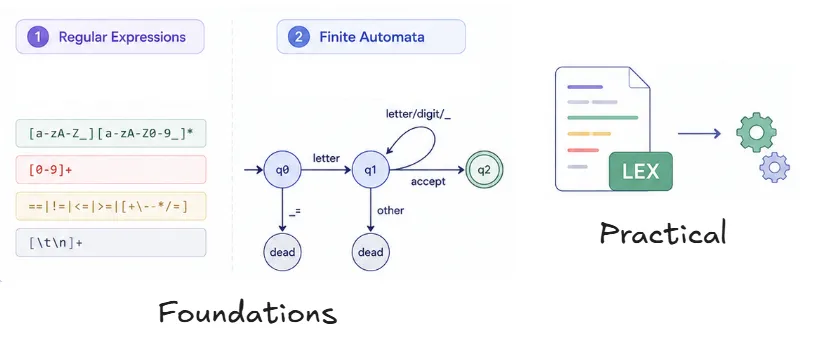
For example:
[a-zA-Z_][a-zA-Z0-9_]*→ identifier[0-9]+→ integer==|!=|<=|>=→ operators
In practice, tools like Lex allow developers to write regex-based rules and automatically generate a lexical analyzer from them.
Conclusion
Lexing simplifies the parser’s job by structuring raw text and also provides early error detection (invalid characters, unclosed strings)