Intermediate Code Generation
What Is Intermediate Code?
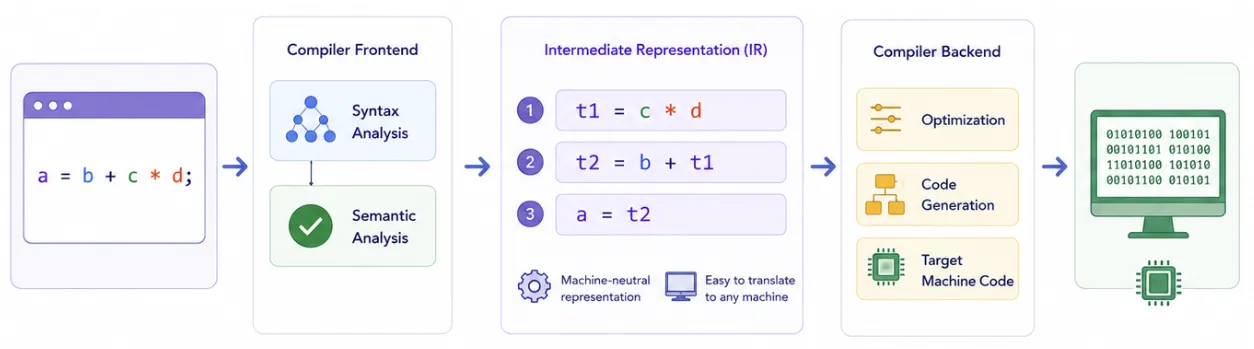
Once the compiler has understood your code (via syntax and semantics), it converts it into an intermediate representation (IR), a form that is not machine code yet, but close enough to be easily translated into it later.
Think of it as a machine-neutral version of your program.
—
Example of Intermediate Code
Lets try to build Intermediate code from following expression a = b + c * d;:
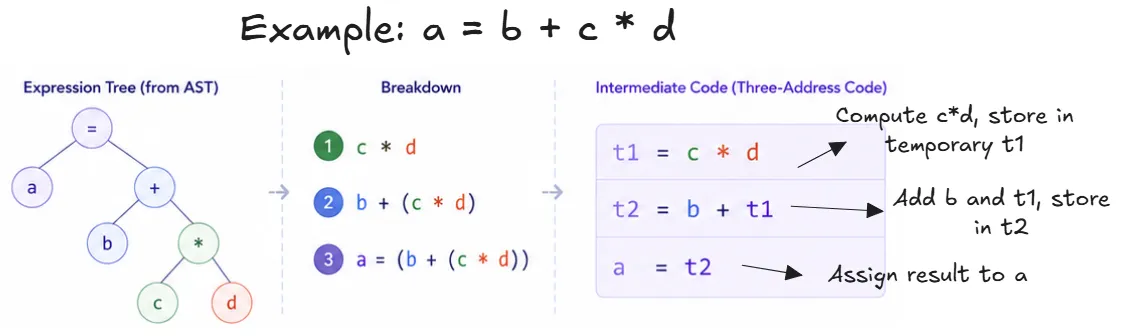
Intermediate Code:
t1 = c * d
t2 = b + t1
a = t2
Why Do We Need IR?
- Portability - The same frontend (parser, analyzer) can target multiple machines via different backends.
- Optimization - Easier to perform code improvements on IR before generating final machine code.
- Simplicity - Abstracts away hardware-level details for now.
Common IR Forms
Different compilers use different forms of Intermediate Representation (IR) depending on the type of analysis or optimization being performed. Some IRs are linear and instruction-based, while others focus on control flow or data dependencies.
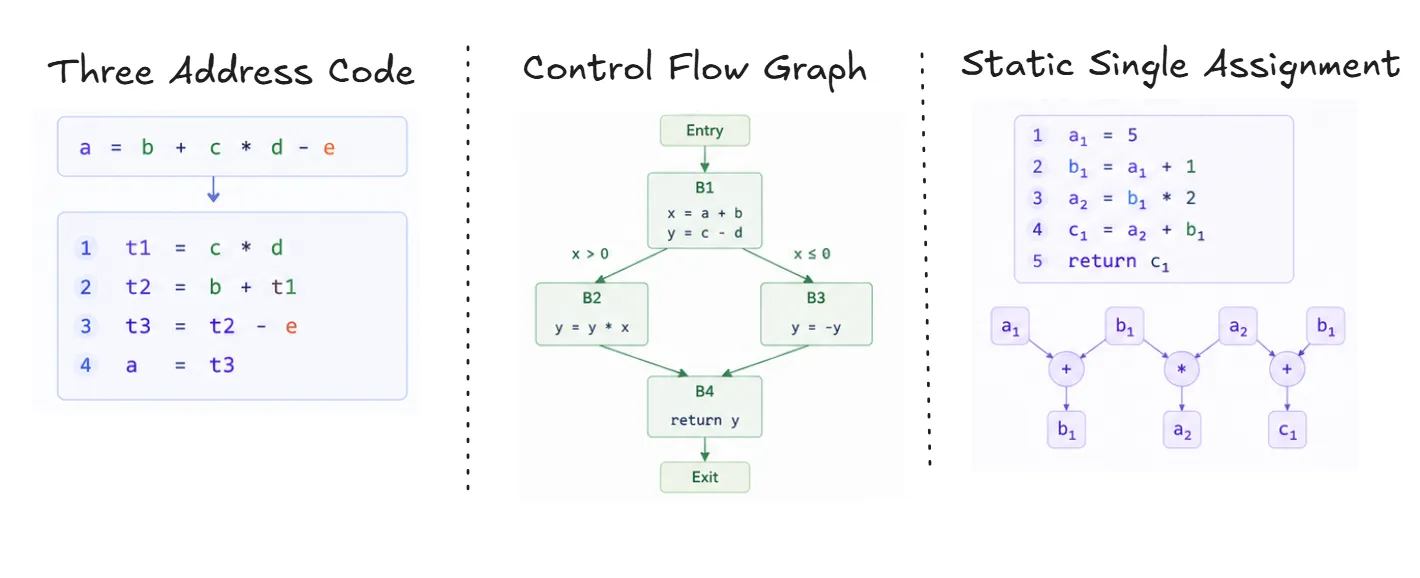
Three-address code (TAC)
Three-address code breaks complex expressions into smaller instructions using temporary variables.
t1 = c * d
t2 = b + t1
t3 = t2 - e
a  = t3
Each instruction usually contains: one operator two operands and one result
This makes TAC:
- simple to generate
- easy to optimize
- convenient for machine-independent transformations
Many compilers internally convert high-level code into TAC-like representations before optimization.
Control Flow Graphs (CFGs)
A Control Flow Graph represents how execution moves between different blocks of code. Each node represents a basic block, and edges represent possible control flow paths.
CFGs are especially important for:
- branch analysis
- loop detection
- dead code elimination
- data-flow analysis
- compiler optimizations
They help the compiler understand the overall structure of a program beyond individual instructions.
Static Single Assignment (SSA)
Static Single Assignment (SSA) is a special IR form where every variable is assigned exactly once.
Instead of reusing variable names:
x = x + 1
SSA creates new versions:
x1 = 5
x2 = x1 + 1
This makes data dependencies explicit and greatly simplifies compiler analysis.
Note - Many production compilers like LLVM and GCC internally rely on SSA-based IRs.
Conclusion
- Intermediate Code bridges semantic understanding and machine execution
- Makes code portable, optimizable, and easier to analyze
- Forms like three-address code are widely used