Processor Organization
If computer architecture is the blueprint, the processor is the engine that makes it all run. In this article, we explore the internal structure of a CPU, what it’s made of and how its parts interact.

CPU Architecture
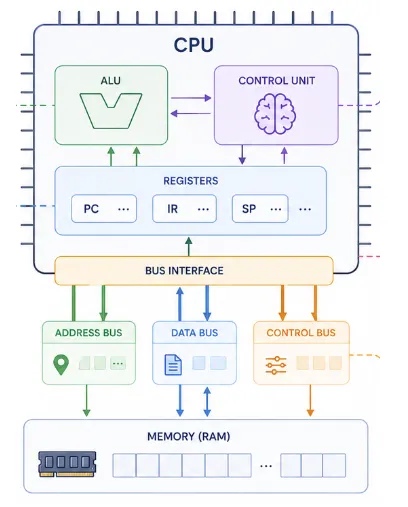
The CPU is the central hub of computation. It integrates multiple components - ALU, registers, buses, clock, and control unit working together to execute instructions efficiently.
The ALU: Where the Actual Work Happens
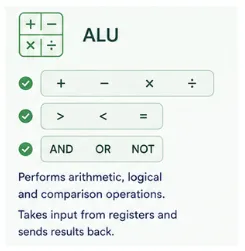
Arithmetic Logic Unit (ALU) is the CPU’s calculator. It performs:
- Arithmetic operations (addition, subtraction, multiplication, division)
- Logical operations (AND, OR, NOT, comparisons)
Inputs come from registers, results are stored back in registers or memory, and everything is orchestrated by the Control Unit
Registers: The CPU’s Short-Term Memory
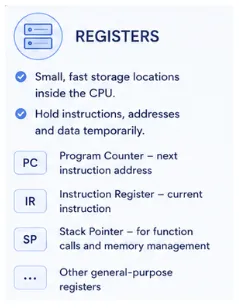
Registers are tiny storage units inside the processor, used for holding temporary data. They’re much faster than RAM, but also much smaller in number.
Some of the registers are -
- Program Counter (PC): Points to the next instruction
- Instruction Register (IR): Holds the current instruction being decoded
- Stack Pointer (SP): Manages function calls and stack memory
Buses: The Communication Highways
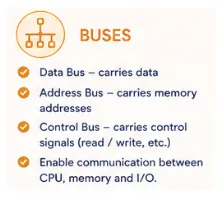
To move data between the ALU, memory, and registers, CPUs use buses (shared electrical lines). All operations in the CPU depend on these buses to stay synchronized.
- Data Bus: Carries actual data/instructions
- Address Bus: Carries memory addresses
- Control Bus: Carries control signals (Read/Write/Clock/Interrupt)
Without buses, the CPU would be a collection of isolated parts
Clock: The Pulse of the Processor
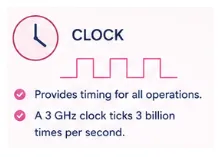
The clock is the CPU’s heartbeat. It sends rhythmic electrical pulses that synchronize operations.
- A 3 GHz clock ticks 3 billion times per second.
- Faster clocks mean more instructions per second, but also higher power consumption.
The Control Unit: The CPU’s Brain
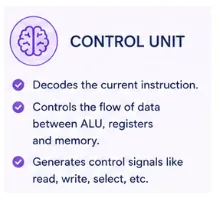
The Control Unit directs traffic inside the CPU. It:
- Decodes instructions
- Signals the ALU to perform operations
- Selects registers for input/output
- Coordinates memory reads and writes
It ensures that every part of the CPU works in harmony.
Conclusion
Every program you use (browser, games etc) ends up as a series of binary instructions. These instructions flow through this internal structure where registers hold intermediate values, ALU computes. registers hold result, everything flows through a bus, synchronized using a clock and managed by Control Unit.