Addressing Modes
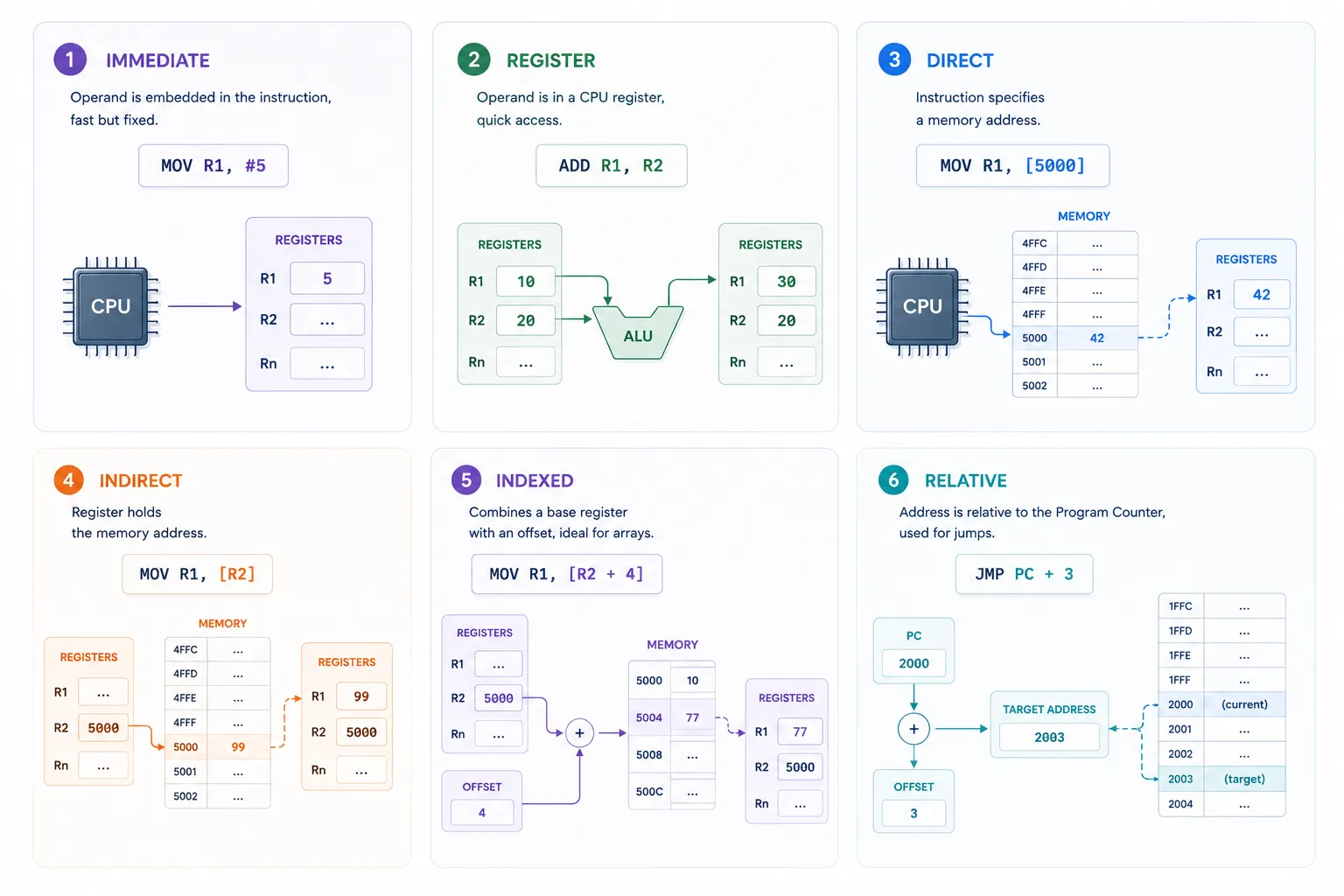
Addressing modes define how a CPU locates operands (data) for instructions, enabling efficient access to registers, memory, or immediate values. It is important specially for operations like loops and array access.
Common Addressing Modes
| Addressing Mode | Description | Example |
|---|---|---|
| Immediate | Operand is embedded in the instruction, fast but fixed. | MOV R1, #5 (Loads 5 into R1) |
| Register | Operand is in a CPU register, quick access. | ADD R1, R2 (Adds R2 to R1) |
| Direct | Instruction specifies a memory address. | MOV R1, [5000] (Loads value at address 5000 into R1) |
| Indirect | Register holds the memory address. | MOV R1, [R2] (Loads value at address in R2 into R1) |
| Indexed | Combines a base register with an offset, ideal for arrays. | MOV R1, [R2 + 4] (Loads value at address R2+4 into R1) |
| Relative | Address is relative to the Program Counter, used for jumps. | JMP PC + 3 (Jumps to PC + 3 bytes) |
Visual Example of all Addressing Modes