Control Unit Explained
The Control Unit (CU) is the CPU’s command center, directing all operations by decoding instructions and coordinating the ALU, registers, and memory.
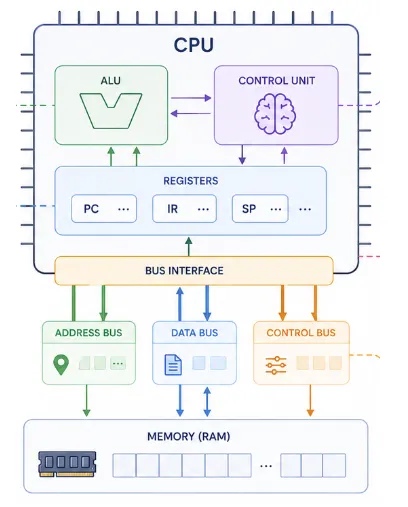
Role of the Control Unit
The CU manages the execution of each instruction by -
- Generating control signals to activate components.
- Directing data flow between registers, ALU, and memory.
- Synchronizing operations with the CPU’s clock.
- Updating the Program Counter to fetch the next instruction.
How the Control Unit Works ?
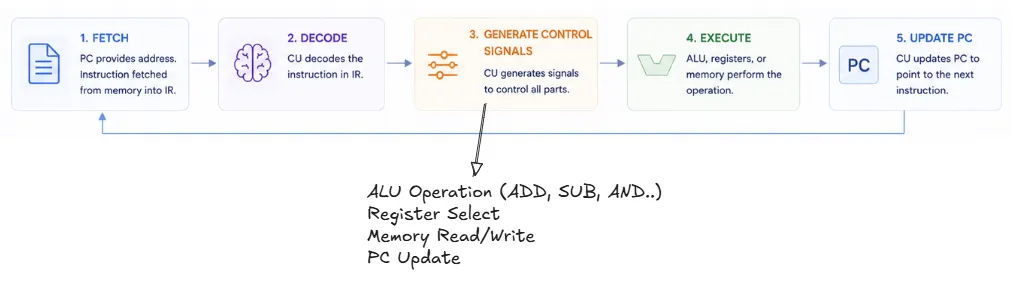
During the instruction cycle:
- The CPU fetches an instruction into the Instruction Register (IR).
- The Control Unit decodes the instruction.
- It generates control signals for different CPU components.
- The required operation executes.
- The Program Counter updates to the next instruction.
Types of Control Units
1. Hardwired Control Unit
Built using fixed logic circuits (combinational logic + timing signals). It is fast and efficient, but inflexible as changing behavior requires redesigning hardware.
2. Microprogrammed Control Unit
Stores micro-instruction in control memory(ROM). It is slightly slower but easier to extend, used in complex CPUs like the Intel 8086.
Conclusion
The Control Unit is the decision-making and coordination component of the CPU. By decoding instructions and generating control signals, it ensures that registers, memory, the ALU, and other CPU components work together correctly during program execution.