Process Synchronization Solutions
Process synchronization is essential for coordinating multiple processes that access shared resources, preventing race conditions and maintaining system stability. Various solutions exist, ranging from basic two-process methods to OS-level and hardware-based techniques.
Two-Process Synchronization Solutions
1. Turn Variable Method
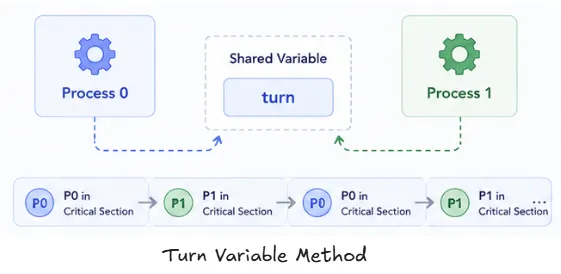
This simple approach ensures mutual exclusion by using a shared variable to determine which process can enter the critical section.
Example: Imagine two processes updating a shared counter. The turn variable ensures only one modifies the counter at a time.
while (turn != process_id) {
    // Wait for your turn
}
// Critical Section
turn = next_process_id; // Pass the turn
🔹 Pros: Simple, prevents simultaneous access.
🔹 Cons: Not efficient when handling more than two processes.
2. Peterson’s Algorithm
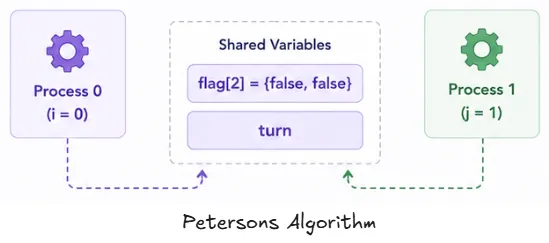
A well-known synchronization solution for two processes, using flags and a shared turn variable to regulate access.
Example: Suppose two threads modify a shared array; Peterson’s Algorithm ensures that only one thread enters at a time.
flag[i] = true;
turn = j;
while (flag[j] && turn == j) { /* Wait */ }
// Critical Section
flag[i] = false;
🔹 Pros: Ensures mutual exclusion, progress, and bounded waiting.
🔹 Cons: Works only for two processes, inefficient for larger systems.
OS-Level Synchronization Solutions
Semaphores
Semaphores provide controlled access to shared resources using a counter to track availability.
Example: In database servers, semaphores manage concurrent connections, ensuring limited users can modify records simultaneously.
semaphore.wait();
// Critical Section
semaphore.signal();
🔹 Binary Semaphore: Works like a mutex, allowing only one process at a time.
🔹 Counting Semaphore:* Allows multiple processes to access based on resource availability.
Hardware-Based Synchronization
Modern CPUs provide low-level atomic operations for process synchronization without OS intervention.
1. Test-and-Set
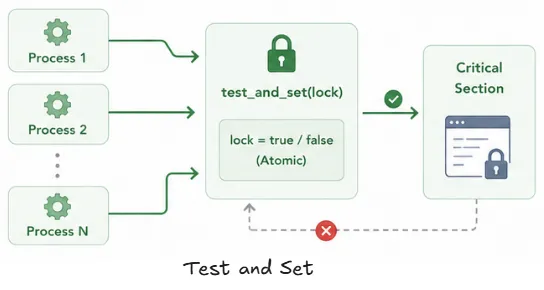
Used to implement locks that prevent race conditions.
while (test_and_set(lock)) {
    // Wait until lock is released
}
// Critical Section
lock = false;
🔹 Used in: Multi-threading environments where performance is critical.
2. Compare-and-Swap
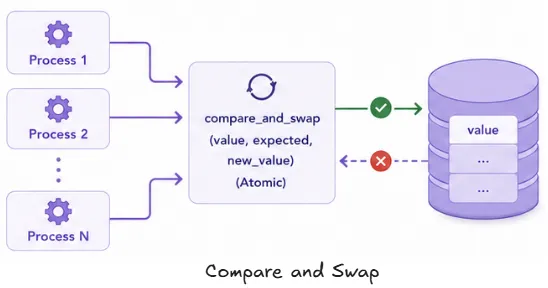
Ensures that a process updates a value only if the expected condition holds, preventing interference.
if (compare_and_swap(value, expected, new_value)) {
    // Perform update
}
🔹 Used in:* Atomic operations in high-performance systems like database indexing and OS scheduling.
Conclusion
Process synchronization solutions like Peterson’s Algorithm, semaphores, and hardware-based locks help prevent race conditions, deadlocks, and inconsistent data modifications in multi-process environments. Whether managing database transactions, coordinating cloud services, or handling concurrent execution in operating systems, choosing the right synchronization method ensures efficient and stable performance.