Regular Expressions & Regular Languages
What Are Regular Expressions?
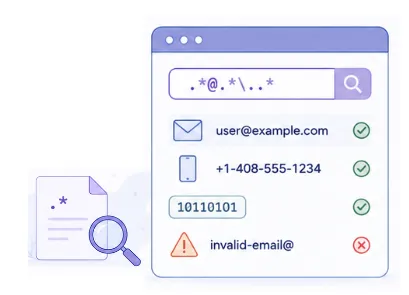
Regular expressions (regex) are a way to describe patterns in strings, like emails, numbers, or binary sequences. They are simple but powerful tools and directly relate to finite automata.
Example of Regular Expressions
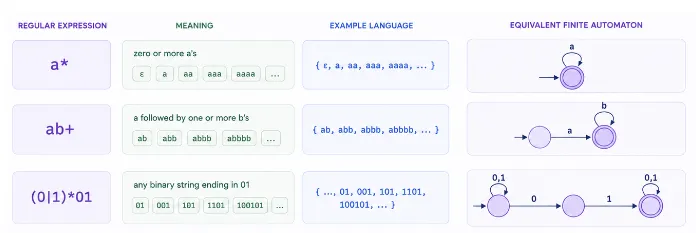
a*means zero or more a’sab+meansafollowed by one or more b’s(0|1)*01means any binary string ending in 01
Regular Languages
A regular language is a set of strings that can be described using a regular expression or recognized by a finite automaton (DFA or NFA). e.g - All strings of even length, Identifiers (like int, x2, etc)
What makes a language Regular?
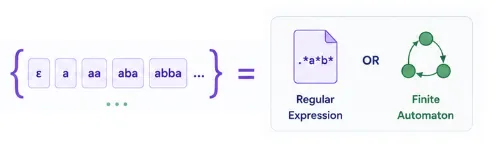
Lets, concretify what we brushed past in definition. If any of the following is true, the language is regular.
- Described by Regular Expression: The language can be expressed using symbols like |, *, +, ?, () and concatenation.
- Recognized by Finite Automata: There exists a DFA or NFA that accepts exactly the strings in the language.
Examples of Regular Languages
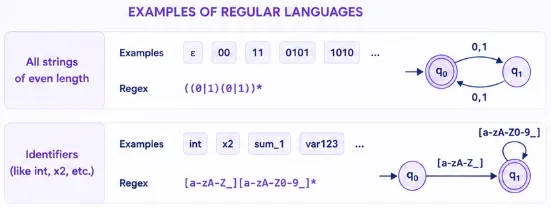
((0|1)(0|1))*is a regex represnting the regular language - All strings of even length[a-zA-Z_][a-zA-Z0-9_]*is a regex representing identifiers like int, x2, num1 etc.
Connection between Regex, Regular Language and Finite Automata
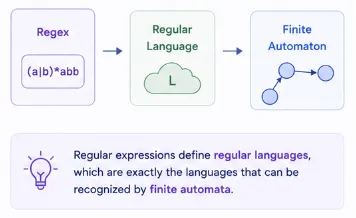
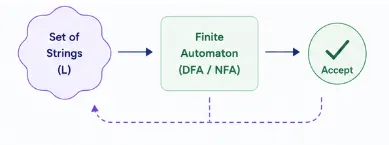
Regular expressions are more than just powerful search patterns, they formally describe regular languages. A regular language is a set of strings that can be recognized by a finite automaton. In other words, every regular expression corresponds to a regular language, and every regular language can be represented by some finite automaton.
Pumping Lemma
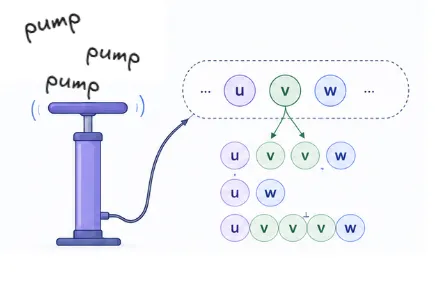
The Pumping Lemma helps prove that a language is not regular by showing it can’t be recognized by a finite automata.
Why would we need pumping lemma ?
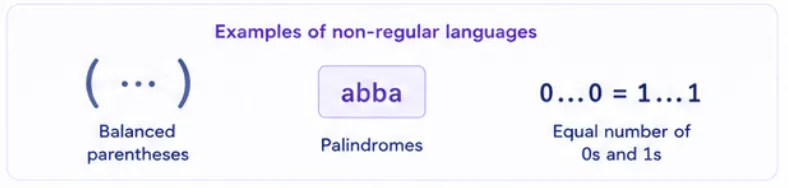
Sometimes, we want to show that a pattern is too complex for a finite automata like. e.g - Balanced parentheses, Palindromes or a Equal number of 0s and 1s.
Pumping Lemma says:
If a language is regular, then long enough strings in the language can be “pumped” i.e., parts of the string can be repeated and the result will still be in the language.
Formal definition of Pumping Lemma
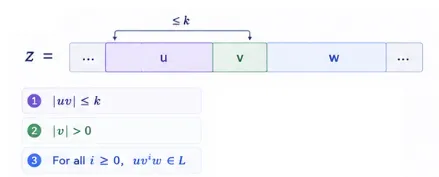
If a language L is regular, there exists a pumping length k such that for any string z in L with length |z| >= k, we can split z = uvw where:
- |uv| <= k (the first part is within k symbols).
- |v| > 0 (the pumped part is not empty).
- For all i >= 0, uv^iw is in L (repeating v zero or more times keeps the string in L).

If we find a string where pumping fails, the language is not regular.
Example of Pumping Lemma
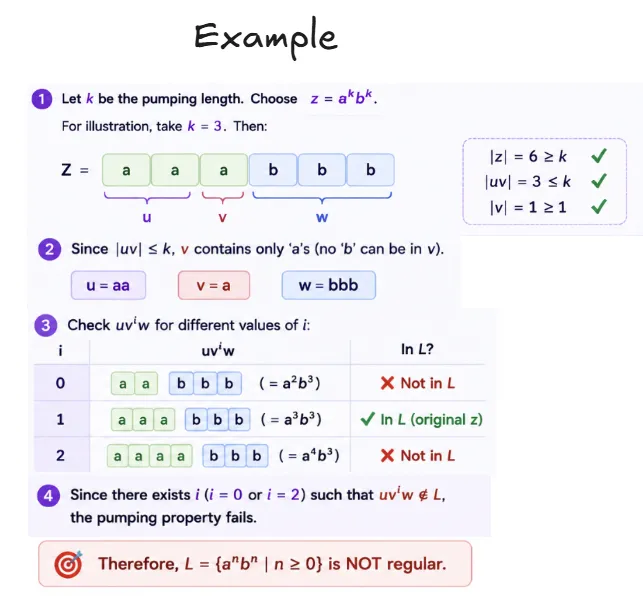
Lets take a language L={ a^nb^n} ., and try to prove if its non-regular (Spoiler alert - It is)